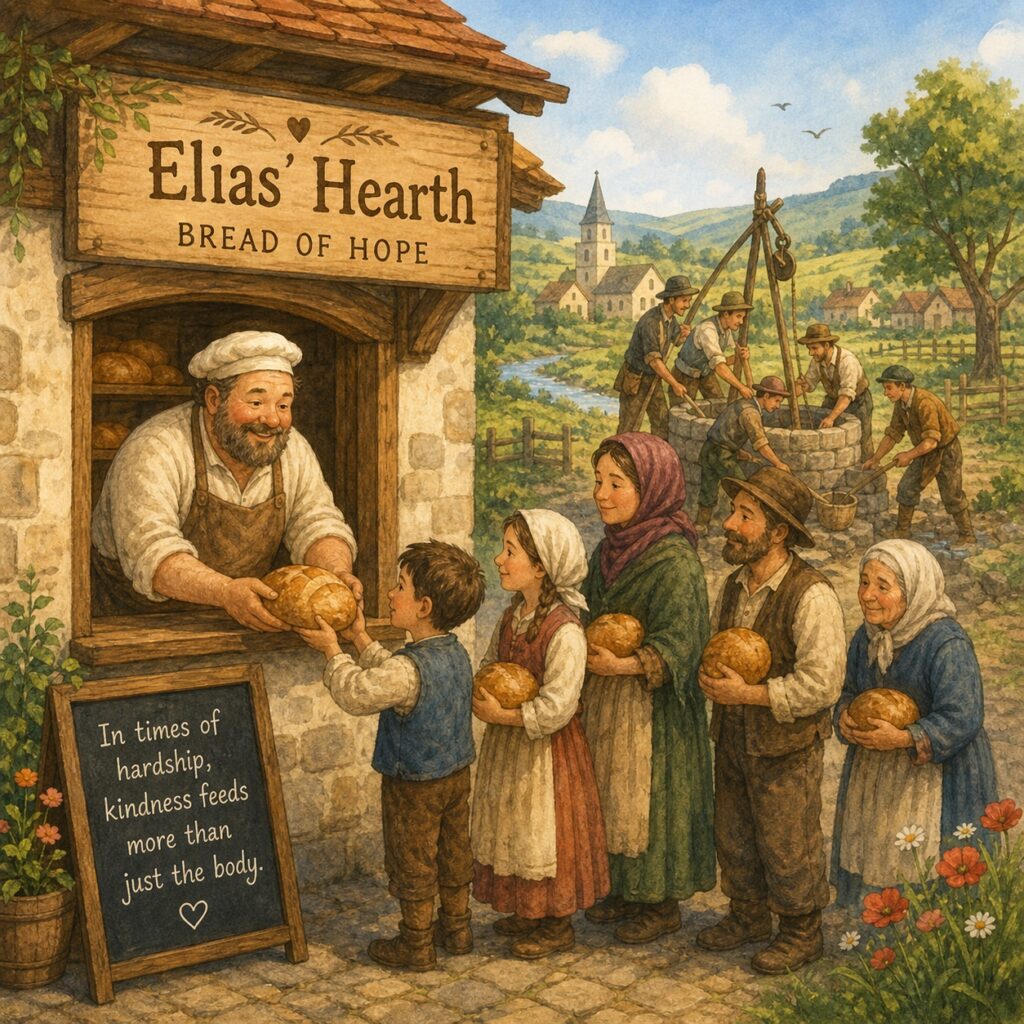
Bread of Hope: Elias’ Bakery
September 4, 2023
Author: Thomas Alexander Kolbe
In a valley where low hills folded into wide meadows, there stood a village called Meadowbrook. It was a quiet place, the kind where mornings arrived softly and evenings settled without fuss. At its center was a small bakery with a wooden sign that read Elias’ Hearth. Long before sunrise, a warm glow would appear behind its windows, and soon after, the smell of bread would drift through the streets.
Elias, the baker, had worked there for as long as anyone could recall. He was a broad man with steady hands and a calm, attentive way of speaking. He had learned his craft from his grandmother, who had taught him not only how to measure flour and time a rise, but how to listen – to dough, to people, to what was needed in a given moment. Those lessons stayed with him.
Meadowbrook had known many uneventful years. The fields were reliable, the streams clear, and the rhythm of life rarely interrupted. Then one season, the rain stopped.
At first, no one worried. A dry week, then another – it had happened before. But the weeks stretched into months. The ground hardened. Crops failed in patches, then across entire fields. Wells sank lower each day. The green that defined the valley faded into a dull, brittle brown.
People began to count what they had left. Food was stored carefully. Conversations grew shorter, quieter. There was no panic yet, but there was a growing awareness that things were changing.
Elias noticed it in small ways. Fewer people came to the bakery. When they did, they hesitated before ordering, calculating silently. He saw it in their faces, in the way they lingered, as if the warmth inside the bakery offered something they could not quite name.
One evening, after closing, Elias stood alone among the empty trays. He looked at the remaining sacks of flour, the jars of preserved fruit from previous harvests, the tools worn smooth by years of use. He understood the limits of what he had – but also its potential.
The next morning, he opened earlier than usual.
Before dawn, the ovens were already hot. He worked methodically, without hurry. Dough was mixed, folded, shaped. Bread, simple and dense. Pastries, modest but careful. Pies filled with what fruit remained from better seasons. By the time the first light touched the hills, the bakery was ready.
People arrived, drawn by habit, by hunger, by the familiar scent. They formed a line, uncertain at first.
Elias greeted each person the same way – with a steady look and a few quiet words. When they reached the counter, he handed them what he had made.
No one was asked to pay.
At first, this confused people. Some insisted. Others tried to leave what little they could spare. Elias accepted nothing. He explained it simply: “We’ll keep each other going. That’s enough.”
Word spread quickly. The bakery became a place people returned to, not only for food but for a sense of steadiness. The routine mattered. The act of showing up mattered.
Something shifted in the village.
A farmer brought what vegetables had survived in a shaded corner of his land. A seamstress began repairing worn clothing without charge. A carpenter offered to reinforce roofs and storage spaces. No one announced these decisions. They followed the same logic Elias had set in motion.
The drought did not ease. Days remained dry, the sky unchanged. But the village adjusted.
Work became shared. Tasks overlapped. People who had never spoken much before found themselves cooperating. Plans formed – practical ones. A group began digging for a deeper water source. Others studied older methods of irrigation, adapting what they could with the tools available.
Through it all, the bakery remained active.
Elias expanded his role without making a point of it. When there was time between batches, he showed others how to bake. Not as instruction in the formal sense, but as a series of gestures – how to feel when dough was ready, how to judge heat without instruments, how to work with what was available rather than what was ideal.
Children learned alongside adults. The act of baking, repetitive and physical, created a kind of focus that helped quiet the constant concern. Bread became something more than food. It was a process people could rely on.
Weeks passed.
Then, one afternoon, a group working beyond the edge of the village struck damp soil. They dug further. Water began to seep through – slow at first, then steady. An underground spring.
The news spread without shouting. People gathered, not in celebration exactly, but in recognition. The work that followed was careful. Channels were dug. Water was directed, conserved, shared.
Gradually, the land responded. Small patches of green returned. The air shifted, almost imperceptibly at first. Meadowbrook began to recover.
Life did not return to what it had been before. It moved forward differently.
The bakery remained at the center, but it had changed. It was no longer just a place where one man worked and others bought. It was a place where knowledge had been passed on, where effort had been distributed, where people understood their connection to one another in practical terms.
Elias continued to bake, as he always had. His movements remained steady, his attention precise. But he was no longer working alone in the way he once had.
Years later, visitors to Meadowbrook would still notice the bakery first. They would remark on the bread, on the atmosphere, on the sense that the place held something more than its outward appearance suggested.
The villagers did not speak often about the drought. When they did, they spoke in specific terms – about the work, the decisions, the adjustments. And about the moment when one person chose to act without waiting for conditions to improve.
Elias never described what he had done as unusual. To him, it had been a direct response to what was needed.
But the effects remained.
Meadowbrook endured, not because the hardship had passed, but because the people within it had changed how they responded to it. The bakery stood as a quiet reminder of that shift – a place where flour, water, and time came together, and where something steady could be made, even under uncertain conditions.