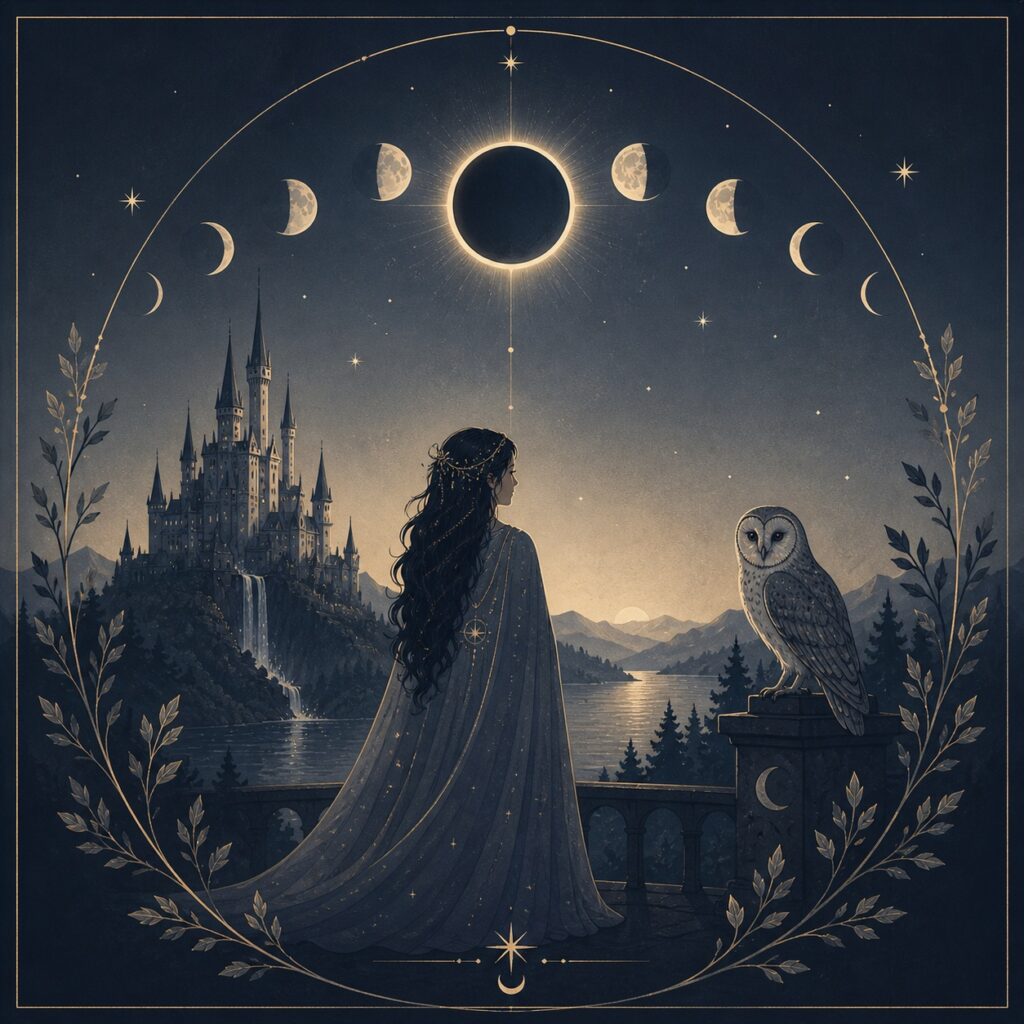
The Story of Seraphina – The Eclipse and the Returning Light
October 23, 2023
Author: Thomas Alexander Kolbe
There was a country where night did not close the world, it opened it.
Stories moved across the sky, slow and legible, written in cold fire.
The moon did not illuminate so much as it remembered.
They called this country Lumiara.
At its center stood a castle that seemed less built than gathered – pale stone holding light the way water holds a reflection. Towers rose like quiet questions. Windows did not shine; they breathed.
Seraphina lived there.
No one spoke of her power in terms of force. It behaved more like listening. Moonlight bent around her hands as if it had been waiting for direction. What she did felt less like casting and more like allowing – fields thickened, wounds closed, unrest softened into something livable.
On certain nights, she stepped into the open court. There was no announcement. People came anyway. She moved, and with her movement the sky altered its tone. Colors appeared that had no names in daylight. The kingdom watched without applause.
It held.
And yet, there was a part of Lumiara that did not receive her.
Beyond the last silver terraces began the Shadowwood. No boundary marked it clearly. The light simply stopped arriving. Trees grew there without reflection, their forms absorbing rather than answering.
Something had taken root in that absence.
They called it the Shadow King, though no one agreed on what that meant. A figure, perhaps. Or a persistence. A will that did not want to be seen, only to remain.
For a long time, nothing happened. Not peace, not conflict. A kind of suspension. Light and shadow did not meet; they avoided one another with precision.
But absence accumulates.
The first sign was not darkness. It was hesitation. The moon dimmed not by vanishing, but by failing to decide. Its edge blurred. Its presence thinned.
An eclipse began without drama.
In the city, voices lowered. Not from fear exactly, but from recognition. Something had shifted from distance into relevance.
Seraphina did not wait for confirmation. She left before anyone asked her to.
The forests beyond the city were still receptive to her. Light moved there, though more slowly. Paths did not guide her so much as align with her pace. She followed what remained responsive until the trees opened into the Celestial Grove.
At its center stood the Moonrise Tree. Its leaves carried a pale internal glow, not bright enough to illuminate, but enough to be noticed. Beneath it waited the Silver Owl.
It did not greet her.
“Light does not disappear,” it said after a while. “It withdraws when it is not understood.”
Seraphina did not answer. She knew the difference between being told something and being given it.
The owl turned its head once, as if marking a position in the sky that could not be seen.
“There is a pattern older than your work. Not stronger. Just deeper. You have used the surface of it.”
“And beneath?” she asked.
“Not beneath. Prior.”
It showed her nothing in the usual sense. No gesture, no spell. Only a sequence she could not repeat in words. A relation between phases. A way the moon held itself even when it seemed incomplete.
She remained there longer than the night required.
When she returned, the eclipse had reached its narrowest point. The moon was still present, but only as a thin, uncertain line.
The Shadowwood did not wait any longer.
Darkness moved without direction. It did not advance; it occupied. Edges dissolved. Structures lost contrast. The castle remained visible only because it remembered its own outline.
Seraphina went to the highest tower.
No one followed her. There was nothing to witness that would translate into sight.
She did not raise her hands. She did not speak in the way spells are spoken.
She aligned.
The moon responded, not by brightening, but by stabilizing. Its thin line held. Then widened. Not quickly. Not dramatically. But with a clarity that did not permit interruption.
Light returned not as force, but as definition.
The Shadowwood did not burn away. It receded into its own limits, no longer able to extend without shape. The presence that had called itself king dissolved into something smaller, less certain, no longer able to hold continuity.
By the time the eclipse passed, nothing looked different at first glance.
But the air had changed. It no longer carried hesitation.
Lumiara continued.
Not with celebration, but with a steadier kind of presence. Nights gathered again. People came to the open court, though less frequently. There was less need.
Seraphina remained where she had always been, though less visible. Her work shifted. Less intervention. More attention.
Time passed without marking itself.
Then, slowly, another change.
The moon did not dim this time. It fractured. Not visibly – not to the eye – but in its effect. Its light reached the ground unevenly, as if arriving from different distances.
Harvests remained. Health remained. But coherence loosened.
Seraphina noticed before anyone spoke.
She called the others.
The Silver Owl returned without being summoned. The Starlight Sylphs gathered like traces of movement rather than bodies. The Whispering Willows did not move at all; they were already present.
Together they opened the Astral Codex.
It did not predict. It described a condition: a convergence that required participation. Not survival. Not defense. Alignment.
“If the pattern is not met,” the owl said, “the light will not leave. It will cease to function.”
That was different.
Seraphina did not argue. She left again.
The Celestial Pathways were not roads. They appeared only when entered. Each step required a decision that could not be revised.
The Astral Garden received her first.
Stars there were not fixed. They moved in low arcs, as if uncertain of their placement. One had fallen – not down, but aside. Its position no longer corresponded to the rest.
The sylphs did not explain.
Seraphina did not sing in the way she had before. The melody she used had no beginning. It entered where it was needed. The star responded gradually, adjusting not its brightness, but its relation to the others.
When it settled, the sky above the garden held again.
She continued.
At the Lunar Observatory, the owl presented no riddles. Only maps. Constellations drawn in forms that did not match any visible sky.
“These are not what you see,” it said. “They are what allows seeing.”
She traced them, not with her hands, but with attention. Patterns aligned, then dissolved, then reformed in a way that no longer required correction.
The Willows received her last.
They did not speak in sentences. Their memory was continuous. She entered it without resistance.
What she found there was not history as events, but as continuity of relation. The kingdom had always depended on something it did not generate. Not power. Orientation.
When she left them, she did not carry new knowledge. She carried fewer separations.
The Celestial Altar did not appear until she stopped looking for it.
It was not elevated. It was precise.
There, the convergence had already begun. Bodies in the sky moved toward one another without urgency, but without deviation.
Seraphina did not intervene. She did not direct.
She held the relation.
The movement above responded. Not because it was controlled, but because it was met.
When she returned to Lumiara, the moon had thinned again – but this time without instability. It was simply incomplete.
That was enough.
From the tower, she did not cast anything.
She allowed the alignment to complete.
The sky arranged itself. Not into spectacle, but into coherence. The moon filled, not with brightness, but with function restored. Its light reached the ground without distortion.
Lumiara did not erupt. It settled.
From that point on, nothing needed to be proven.
The nights continued. The court remained open. The Shadowwood stayed where it belonged, no longer pressing outward, no longer expanding through absence.
Seraphina did not become a figure of legend. She remained available, which mattered more.
And Lumiara endured – not because it resisted darkness, but because it no longer mistook light for something it owned.