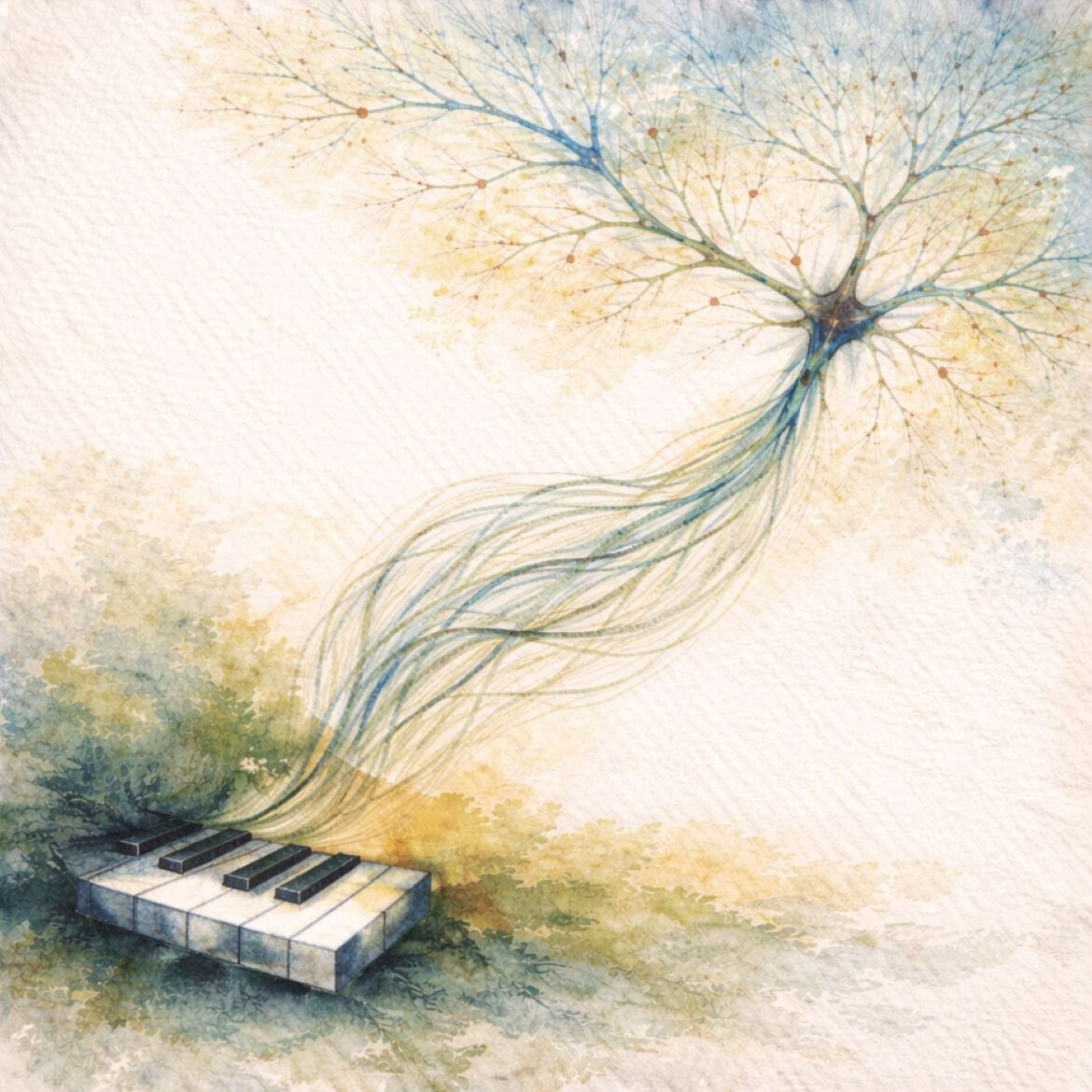
My interest in the relationship between music and cognition did not originate in academic research but in everyday creative practice. While composing and producing music, I repeatedly noticed that certain musical decisions generated remarkably consistent reactions. A harmonic shift intensified the emotional atmosphere of a piece. A rhythmic alteration created momentum. A change in texture transformed the perceived character of a track.
At first these moments seemed like expressions of artistic instinct. Musicians often describe their work in terms of intuition or feeling. Yet over time a pattern became apparent. Similar musical gestures frequently produced comparable responses. This observation raised a simple question. If specific musical structures evoke consistent reactions, what occurs in the listener’s mind during musical perception?
Music is not only an artistic medium but also an acoustic stimulus processed by the human brain. Rhythm interacts with motor systems, harmony influences emotional interpretation, and melodic structure shapes expectation and memory. Many decisions musicians make intuitively correspond to perceptual mechanisms studied in cognitive science.
Encountering research on music cognition therefore felt less like entering a new field than finding explanations for phenomena already familiar from practice. Concepts such as auditory expectation, neural entrainment, emotional processing, and musical memory provided language for experiences previously understood only intuitively.
At the same time, music cannot be reduced to predictable formulas. Artistic creation depends on personal expression, ambiguity, and the unexpected. Scientific knowledge therefore does not replace intuition. It clarifies how listeners perceive sound while leaving the creative process open.
This essay grows from that intersection. It examines how insights from cognitive science can inform musical practice without diminishing the intuitive character of composition and production.
1. Introduction: Creativity, Music, and Cognition
1.1 Creativity in Musical Practice
Creativity in music emerges from the interaction between individual artistic intention and broader cultural and perceptual frameworks. Musical works communicate ideas, emotions, and narratives through organized sound.
Composers and producers operate within networks of influence that include personal experience, cultural tradition, and historical context. A composer may reinterpret traditional melodies through contemporary harmony, while a producer may construct sound environments that evoke specific psychological states.
Musical creativity therefore combines intuition and knowledge. Harmonic theory, rhythmic structure, orchestration, and arrangement provide technical frameworks, while intuition guides artistic decisions within them.
Cognitive science offers insight into this process by examining how the brain generates and interprets musical ideas. Musical activity involves multiple neural systems. Memory networks contribute stored knowledge, emotional centers influence expressive intent, and motor systems participate in rhythm perception and timing. The prefrontal cortex supports generative thinking and evaluation of musical possibilities, while the auditory cortex analyzes acoustic structure.
Creativity in music extends beyond the composer. Listening itself involves cognitive and physiological responses. Harmonic tension, rhythmic drive, and dynamic contrast influence emotional reactions, bodily responses, and memory formation.
Musical creativity therefore connects personal expression with shared perceptual mechanisms. Composers communicate individual ideas through structures that listeners interpret through common cognitive processes.
1.2 Central Question of the Essay
This essay examines how scientific knowledge about musical perception can inform creative practice. Research in cognitive science provides insight into how listeners interpret harmony, rhythm, melody, and sonic texture.
Musicians traditionally rely on intuition when shaping musical structure. Empirical research clarifies how perception, attention, and emotional response interact with musical elements. Knowledge about harmonic tension, rhythmic entrainment, and auditory expectation therefore provides additional perspectives for composition and production.
The central question concerns how musicians can integrate such knowledge into creative practice without reducing music to formulaic design.
Scientific understanding does not replace artistic intuition. Instead, it explains why certain musical gestures produce strong responses. Studies of musical chills demonstrate that intense emotional reactions often occur during harmonic shifts, melodic peaks, or sudden dynamic expansion. These findings illustrate how musical structure interacts with listener perception.
In a contemporary environment characterized by constant musical availability, creating lasting emotional impressions becomes increasingly difficult. Cognitive insights therefore offer musicians tools for understanding how musical structure shapes listener engagement.
1.3 Objective and Scope
The aim of this essay is to establish a conceptual framework connecting artistic practice with cognitive science.
For musicians and producers, research on auditory perception clarifies how listeners respond to rhythm, harmony, and melodic contour. Studies of dissonance and resolution explain mechanisms of tension and release, while research on auditory attention illustrates how arrangement and dynamic contrast guide listening focus.
For scholars, the essay illustrates how empirical findings relate to practical musical creation. Music functions simultaneously as artistic expression and cognitive stimulus. Connecting these perspectives contributes to a more comprehensive understanding of musical experience.
The framework presented here does not prescribe a method for composition. Instead, it offers conceptual tools that musicians may integrate according to their artistic goals. Individual creative identity remains central.
At the same time, the discussion encourages dialogue between artistic practice and scientific research. Musicians benefit from perceptual insights, while researchers gain understanding of how theoretical findings relate to real creative processes.
2. Creativity and Intuition in Music Production
2.1 Personal Expression and Perceptual Principles

Musical creativity balances individual expression with perceptual tendencies shared among listeners.
Every musician develops a distinctive artistic language shaped by experience, cultural background, and aesthetic preference. Yet certain musical parameters produce broadly consistent perceptual responses. Harmony, rhythm, melody, and dynamics influence emotional interpretation in systematic ways.
Research in music cognition shows that specific acoustic relationships generate recognizable perceptual effects. Harmonic intervals such as octaves and perfect fifths produce stability, whereas dissonant intervals create tension. These responses arise from the auditory system’s processing of frequency relationships.
Rhythm activates neural synchronization mechanisms. When listeners perceive a regular beat, motor regions of the brain align with the rhythmic pattern. This phenomenon, known as entrainment, explains the impulse to move in response to rhythmic music.
Melodic contour also influences emotional interpretation. Ascending lines often convey anticipation or uplift, whereas descending gestures may evoke introspection or dramatic emphasis.
These perceptual regularities provide a shared language through which musicians communicate expressive meaning.
2.2 Cultural Context and Musical Meaning
Perceptual mechanisms interact with cultural learning.
Although some acoustic cues produce similar responses across cultures, musical meaning also depends on familiarity with stylistic conventions. Emotional associations of scales, rhythms, and timbres vary between musical traditions.
Cross cultural studies demonstrate that listeners from different backgrounds recognize emotional intentions when music contains clear cues such as tempo, articulation, and dynamic intensity. Musical meaning therefore arises through the interaction of biological auditory processing and cultural experience.
2.3 Intuition in Creative Decision Making
Despite increasing scientific knowledge about musical perception, intuition remains fundamental to creative practice.
Musicians frequently describe creative decisions as instinctive. In experienced musicians, however, intuition reflects accumulated knowledge rather than randomness. Years of listening, performing, and composing produce implicit memory structures that support rapid pattern recognition.
Research on expertise shows that intuitive judgments rely on these internalized patterns. A jazz improviser selecting a chord substitution or a producer adjusting sonic texture often draws on extensive implicit knowledge rather than conscious analysis.
Neuroscientific studies link intuitive decision making to interactions between memory networks, emotional processing systems, and executive brain regions. These systems allow musicians to evaluate musical possibilities quickly.
The psychological state commonly associated with intuitive creativity is known as flow. During intense concentration, self reflective thought decreases and creative action becomes fluid.
3. Cognitive Foundations of Music Perception
3.1 Perception and Neural Processing

Cognitive science investigates how humans perceive, interpret, and remember information. In the context of music, it examines how the brain processes sound and constructs meaning from acoustic patterns.
Music perception involves several interacting neural systems. The auditory cortex analyzes basic acoustic properties such as pitch, timbre, and rhythm. Higher cognitive regions evaluate patterns, expectations, and structural relationships within the music. Emotional centers associate auditory input with affective responses.
Rhythm perception also engages motor related brain regions, even when no physical movement occurs. This connection explains why rhythmic music often produces a physical impulse to move. Neural synchronization between auditory and motor systems supports the sense of pulse and timing that listeners experience during music.
Attention plays a central role in musical listening. Sudden changes in dynamics, harmony, or texture interrupt established expectations and attract attention. Repetition stabilizes perception and supports memory formation by reinforcing recognizable patterns.
3.2 Emotion and Musical Experience
Music strongly influences emotional states. Neuroscientific research links emotional reactions to activity within the limbic system, including structures such as the amygdala and hippocampus.
Musical parameters often correlate with recognizable emotional impressions. Slow tempos combined with minor tonalities tend to produce reflective or melancholic atmospheres. Faster tempos and brighter harmonic structures frequently create impressions of energy or excitement. These associations arise through interactions between auditory perception and emotional processing systems.
Music also interacts closely with autobiographical memory. Songs connected with personal experiences can evoke vivid recollections long after the original listening context. This relationship between music and memory reflects cooperation between auditory processing systems and memory networks within the brain.
3.3 Reward, Expectation, and Musical Pleasure

One of the most significant discoveries in music neuroscience concerns the activation of neural reward systems during musical listening.
Research demonstrates that emotionally intense moments in music often coincide with dopamine release in the ventral striatum, a region associated with pleasure and reward processing. These moments frequently occur during harmonic resolution, melodic climaxes, or dramatic changes in dynamics.
Musical pleasure therefore arises not only from sound itself but from expectation and its fulfillment. Composers and producers shape these experiences by controlling patterns of tension, delay, and resolution within musical structure.
4. Applying Cognitive Insights to Music Production
Scientific research on music perception provides perspectives that can inform composition, arrangement, and production.
In composition, understanding interval perception and harmonic tension allows composers to design expressive harmonic movement. The use of dissonance followed by resolution can guide emotional progression within a piece.
Arrangement influences how listeners direct their attention during listening. Changes in orchestration, dynamic contrast, and rhythmic variation highlight structural elements and shape the listener’s experience of form and development.
Production techniques also affect musical perception. Frequency balance, spatial placement, and reverberation alter how listeners interpret depth, clarity, and proximity within a soundscape. Psychoacoustic research clarifies how the brain interprets these acoustic cues.
At the same time, applying scientific insights to music production requires careful balance. When used rigidly, perceptual principles can lead to predictable structures that diminish artistic individuality. Creative practice benefits most when analytical knowledge complements rather than replaces intuitive judgment.
5. Examples from Musical Practice
Historical and contemporary works illustrate how musical structure influences perception and emotional response.
Large scale orchestral works such as Beethoven’s Symphony No. 9 demonstrate how harmonic progression, thematic development, and orchestration combine to create powerful emotional trajectories. Film music by composers such as John Williams also relies on harmonic architecture, orchestral color, and thematic association to shape audience perception and emotional engagement.
Contemporary popular music provides further examples. The album Kid A by Radiohead departs from conventional harmonic and rhythmic structures, creating an atmosphere characterized by uncertainty and disorientation. This effect results from deliberate manipulation of expectation and sonic texture.
Advances in digital technology expand opportunities for exploring perceptual principles in music production. Spectral analysis tools, spatial audio systems, and psychoacoustic processing enable musicians to experiment with how listeners perceive sound in increasingly sophisticated ways.
6. Opportunities and Limitations
Integrating knowledge from cognitive science into music creation offers several advantages. Understanding perceptual mechanisms allows musicians to design musical structures with greater awareness of how listeners interpret sound. This awareness can strengthen emotional impact and structural clarity.
However, excessive reliance on perceptual models can lead to formulaic composition. Music depends on ambiguity, surprise, and individual expression. When creative decisions rely too heavily on predictable patterns, artistic originality may diminish.
A balanced approach therefore remains essential. Scientific knowledge clarifies perceptual processes, while intuition and experimentation preserve artistic individuality.
7. Outlook
Research in music cognition continues to expand across fields such as neuroscience, psychology, and acoustics. Future studies will deepen understanding of topics including musical memory, emotional processing, and cultural differences in perception.
For musicians and producers, these developments offer additional perspectives on how sound interacts with human perception. As knowledge grows, creative practitioners gain new tools for understanding the effects their work produces in listeners.
At the same time, artistic practice will continue to influence research by providing real world contexts in which perceptual theories can be tested and refined.
8. Conclusion
Music exists at the intersection of artistic intuition and cognitive perception. Composers and producers shape sound according to personal creative vision, yet the impact of their work depends on how listeners perceive and interpret musical structure.
Scientific research clarifies the mechanisms through which music influences attention, emotion, and memory. These insights do not replace the intuitive nature of artistic creation. Instead, they illuminate aspects of musical experience that musicians already encounter through practice.
When artistic intuition and scientific understanding inform one another, new possibilities emerge for shaping musical expression. This dialogue between art and science deepens both creative practice and our understanding of how music affects the human mind.
Selected References
- Balkwill, L. L., & Thompson, W. F. (1999). A cross-cultural investigation of the perception of emotion in music. Music Perception, 17(1), 43–64. https://doi.org/10.2307/40285811
- Blood, A. J., & Zatorre, R. J. (2001). Intensely pleasurable responses to music correlate with activity in brain regions implicated in reward and emotion. Proceedings of the National Academy of Sciences, 98(20), 11818–11823. https://doi.org/10.1073/pnas.191355898
- Csikszentmihalyi, M. (1990). Flow: The Psychology of Optimal Experience. New York: Harper & Row.
- Ericsson, K. A., Krampe, R. T., & Tesch-Römer, C. (1993). The role of deliberate practice in the acquisition of expert performance. Psychological Review, 100(3), 363–406. https://doi.org/10.1037/0033-295X.100.3.363
- Grahn, J. A., & Brett, M. (2007). Rhythm and beat perception in motor areas of the brain. Journal of Cognitive Neuroscience, 19(5), 893–906. https://doi.org/10.1162/jocn.2007.19.5.893
- Huron, D. (2006). Sweet Anticipation: Music and the Psychology of Expectation. Cambridge, MA: MIT Press. https://doi.org/10.7551/mitpress/6575.001.0001
- Janata, P. (2009). The neural architecture of music-evoked autobiographical memories. Cerebral Cortex, 19(11), 2579–2594. https://doi.org/10.1093/cercor/bhp008
- Juslin, P. N., & Västfjäll, D. (2008). Emotional responses to music: The need to consider underlying mechanisms. Behavioral and Brain Sciences, 31(5), 559–575. https://doi.org/10.1017/S0140525X08005293
- Kahneman, D., & Klein, G. (2009). Conditions for intuitive expertise: A failure to disagree. American Psychologist, 64(6), 515–526. https://doi.org/10.1037/a0016755
- Koelsch, S. (2014). Brain correlates of music-evoked emotions. Nature Reviews Neuroscience, 15(3), 170–180. https://doi.org/10.1038/nrn3666
- Large, E. W., & Jones, M. R. (1999). The dynamics of attending: How people track time-varying events. Psychological Review, 106(1), 119–159. https://doi.org/10.1037/0033-295X.106.1.119
- Large, E. W., & Snyder, J. S. (2009). Pulse and meter as neural resonance. Annals of the New York Academy of Sciences, 1169, 46–57. https://doi.org/10.1111/j.1749-6632.2009.04550.x
- Margulis, E. H. (2005). A model of melodic expectation. Music Perception, 22(4), 663–714. https://doi.org/10.1525/mp.2005.22.4.663
- McDermott, J. H., Schultz, A. F., Undurraga, E., & Godoy, R. A. (2016). Indifference to dissonance in native Amazonians reveals cultural variation in music perception. Nature, 535, 547–550. https://doi.org/10.1038/nature18635
- Meyer, L. B. (1956). Emotion and Meaning in Music. Chicago: University of Chicago Press. source
- Narmour, E. (1990). The Analysis and Cognition of Basic Melodic Structures. Chicago: University of Chicago Press.
- Patel, A. D. (2008). Music, Language, and the Brain. Oxford University Press. https://doi.org/10.1093/acprof:oso/9780195123753.001.0001
- Plomp, R., & Levelt, W. J. M. (1965). Tonal consonance and critical bandwidth. Journal of the Acoustical Society of America, 38(4), 548–560. https://doi.org/10.1121/1.1909741
- Salimpoor, V. N., Benovoy, M., Larcher, K., Dagher, A., & Zatorre, R. J. (2011). Anatomically distinct dopamine release during anticipation and experience of peak emotion to music. Nature Neuroscience, 14(2), 257–262. https://doi.org/10.1038/nn.2726
- Zatorre, R. J., Chen, J. L., & Penhune, V. B. (2007). When the brain plays music: Auditory-motor interactions in music perception and production. Nature Reviews Neuroscience, 8(7), 547–558. https://doi.org/10.1038/nrn2152