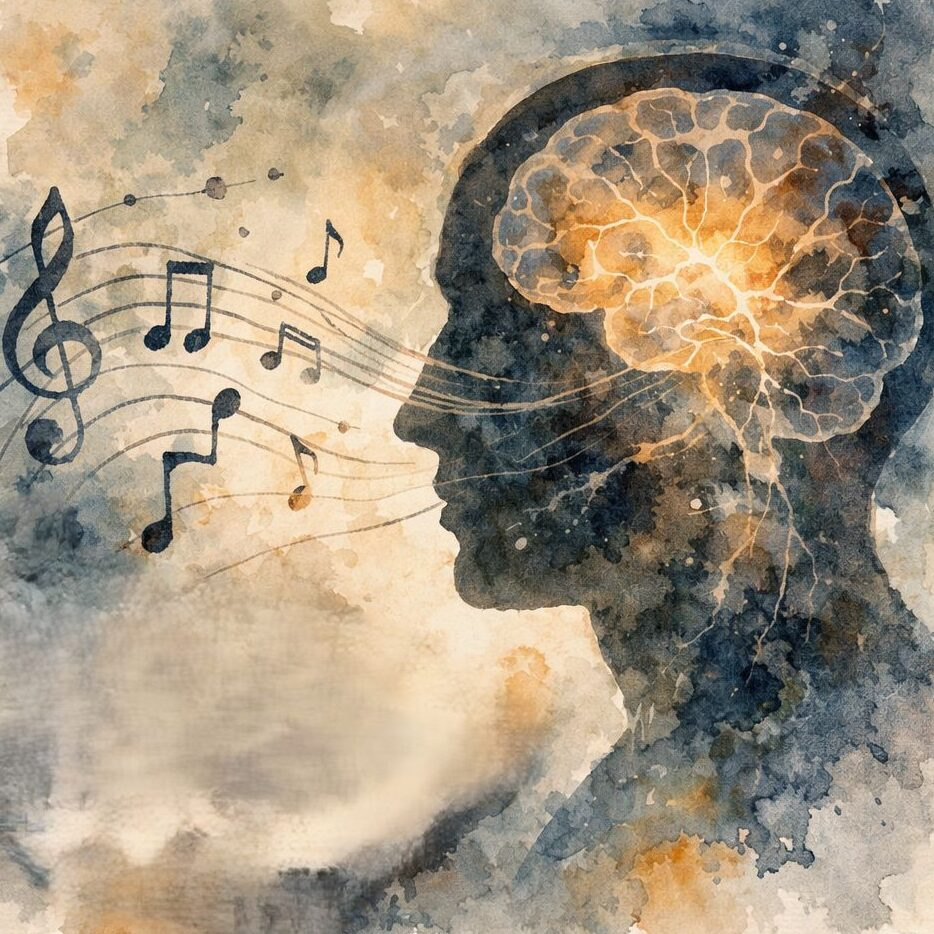
The Neuroscience of Musical Emotion in Composition
March 14, 2026
Author: Thomas Alexander Kolbe
Music has an exceptional capacity to evoke emotional states. For composers, this raises a fundamental question: which musical decisions lead to particular emotional effects? Neuroscientific research does not provide aesthetic rules, but it reveals processes that occur in the brain while listening to music. These processes involve perception, expectation, reward, memory, and bodily responses. Looking at these mechanisms can help explain why certain musical structures exert such a strong impact.
Neuroscientific Foundations of Emotional Music Design
When I compose music, I rarely begin with a clearly defined emotion. It happens occasionally, but it is uncommon. At the beginning there are sound, movement, and structure. Only during the process does an atmosphere take form, emerging from many musical decisions. Neuroscientific research indicates that this experience is not accidental. Music produces emotional effects because it activates several neural systems at the same time – systems responsible for perception, expectation, reward, memory, and bodily regulation.
The emotional effect of a piece of music therefore does not arise from a single parameter such as harmony, tempo, or timbre. It arises from the interaction of these elements over time. The brain processes music as a sequence of structured events. Within this sequence, expectations form, are confirmed or altered, and eventually lead to emotional responses.
From Acoustic Signal to Musical Perception
The processing of musical information begins in the inner ear. Sound waves set the fluid in the cochlea into motion. Hair cells along the basilar membrane convert these mechanical vibrations into electrical signals. These signals travel through the auditory nerve to the auditory cortex in the temporal lobe.
In the primary auditory cortex, fundamental acoustic properties are analyzed. These include frequency, loudness, and temporal structure. This region is organized tonotopically, so that different pitches activate different neuronal populations.
Musical perception, however, does not arise from this area alone. Imaging studies show that music activates a network of multiple cortical regions. These include the planum temporale, the superior temporal gyrus, and prefrontal regions involved in pattern recognition and sequence analysis.
For composition, this network structure has a direct consequence. The brain does not process music as isolated tones. It recognizes patterns. Melodies, rhythmic figures, and harmonic progressions are interpreted as temporal structures and compared with stored musical experience.
Expectation as a Central Mechanism of Musical Emotion
A substantial part of musical emotion arises from expectation. Contemporary models of perception describe the brain as a system that continuously generates predictions about upcoming sensory events. These predictions are based on statistical regularities learned from previous experience.
While listening to music, the brain therefore constantly anticipates which tone, chord, or rhythmic impulse might follow next. When these expectations are fulfilled, perception stabilizes. When they are violated, a so-called prediction error occurs.
This prediction error often carries strong emotional impact. Unexpected musical events activate both auditory cortical regions and the ventral striatum of the reward system. Emotional intensity therefore frequently arises from the interaction between predictability and deviation.
Many compositional techniques rely on this principle. A delayed harmonic resolution, an unexpected modulation, or a rhythmic displacement alters the listener’s expectations. Emotion does not arise from a sound alone, but from its relationship to what has been established before.
The Dopaminergic Reward System
Particularly intense musical experiences activate the brain’s dopaminergic reward system. This system includes, among other structures, the ventral tegmental area and the ventral striatum with the nucleus accumbens.
Neuroimaging studies show that listening to emotionally engaging music can trigger dopamine release. The temporal dynamics of this process are notable. During the anticipation of a musical climax, activity increases in the caudate nucleus. Once the climax occurs, activity shifts toward the nucleus accumbens.
Musical emotion therefore often consists of two closely connected phases: anticipation and reward. A musical climax tends to feel particularly intense when it is prepared. The expectation of the event already activates parts of the reward system before the actual sound arrives.
Emotional Evaluation in the Limbic System
In addition to the reward system, several limbic structures contribute to the emotional processing of musical stimuli. The amygdala evaluates emotional stimuli and responds with particular sensitivity to unexpected musical events.
The hippocampus is more closely associated with memory processes. Music can activate autobiographical memories that often remain highly stable. A particular sound motif can therefore become directly associated with personal experiences or periods of life.
Another relevant structure is the insula. This region links emotional evaluation with bodily states such as heart rate or breathing rhythm. Activity in the insula frequently correlates with intense emotional responses to music.
Music and Autobiographical Memory
The connection between music and memory represents one of the most stable findings in music psychology. Musical stimuli activate a network involving the hippocampus, the medial prefrontal cortex, and temporal memory regions.
This network remains relatively intact even during neurodegenerative diseases. People with dementia can often recognize familiar pieces of music and respond emotionally to them, even when other forms of memory are already severely impaired.
Music therefore functions as a particularly stable marker of autobiographical experience. Timbres, instrumentation, or harmonic styles can evoke memories even when the listener is not consciously aware of the process.
Physiological Responses to Music
Emotional responses to music appear not only in the brain but also in the body. Changes in heart rate, skin conductance, or breathing can be measured during intense musical passages.
These responses arise through interactions between limbic structures, the hypothalamus, and the autonomic nervous system. Particularly intense musical moments can temporarily activate the sympathetic nervous system. The well-known experience of chills while listening to music belongs to these autonomic reactions.
Compositional Consequences
Neuroscience does not provide rules for good music. It does, however, reveal mechanisms that can influence emotional impact.
A central factor is the design of expectation. Harmonic progressions, rhythmic structures, and formal developments generate predictions in the listener’s brain. A controlled deviation from these expectations can create tension.
Rhythm has particular neurological significance. Rhythmic structures activate motor networks in the brain and can produce bodily resonance. A stable pulse can therefore trigger immediate physical responses.
Timbre often influences emotional perception more rapidly than harmonic structure. Instrumentation and spectral density can therefore alter emotional atmosphere immediately.
Finally, temporal development plays a decisive role. Emotional climaxes tend to be stronger when they are prepared. Expectation, tension, and resolution unfold over time.
Conclusion
The emotional impact of music arises from the interaction of several neural systems. Auditory networks analyze acoustic structure, predictive mechanisms generate expectations, the dopaminergic reward system responds to musical climaxes, and limbic structures link these processes with memory and bodily reactions.
Composing therefore also involves working with the perceptual processes of the brain. The design of expectation, tension, and resolution influences neural dynamics that generate emotional experience.
Musical atmosphere does not arise from individual sounds. It arises from the movement of music through time.
References
OA = open access. These are the links under which a study is officially accessible to everyone free of charge.
- Blood, A. J., & Zatorre, R. J. (2001). Intensely pleasurable responses to music correlate with activity in brain regions implicated in reward and emotion. PNAS. https://doi.org/10.1073/pnas.191355898 — OA: https://www.ncbi.nlm.nih.gov/pmc/articles/PMC58814/
- Salimpoor, V. N. et al. (2011). Anatomically distinct dopamine release during anticipation and experience of peak emotion to music. Nature Neuroscience. https://doi.org/10.1038/nn.2726
- Zatorre, R. J., & Salimpoor, V. N. (2013). From perception to pleasure: Music and its neural substrates. PNAS. https://doi.org/10.1073/pnas.1301228110 — OA: https://www.ncbi.nlm.nih.gov/pmc/articles/PMC3690607/
- Ferreri, L. et al. (2019). Dopamine modulates the reward experiences elicited by music. PNAS. https://doi.org/10.1073/pnas.1811878116 — OA: https://www.ncbi.nlm.nih.gov/pmc/articles/PMC6397525/
- Gold, B. P. et al. (2019). Musical reward prediction errors engage the nucleus accumbens and motivate learning. PNAS. https://doi.org/10.1073/pnas.1809855116 — OA: https://www.ncbi.nlm.nih.gov/pmc/articles/PMC6386687/
- Koelsch, S. (2014). Brain correlates of music-evoked emotions. Nature Reviews Neuroscience. https://doi.org/10.1038/nrn3666
- Menon, V., & Levitin, D. J. (2005). The rewards of music listening. NeuroImage. https://doi.org/10.1016/j.neuroimage.2005.05.053
- Bowling, D. L. (2023). Biological principles for music and mental health. Translational Psychiatry. https://doi.org/10.1038/s41398-023-02671-4 — OA: https://www.ncbi.nlm.nih.gov/pmc/articles/PMC6688399/
- Fuentes-Sánchez, N. et al. (2025). Neuroimaging meta-analysis of music-evoked emotions. Imaging Neuroscience. https://doi.org/10.1162/imag_a_00425 — OA: https://www.ncbi.nlm.nih.gov/pmc/articles/PMC12319861/
- Sachs, M. E. et al. (2025). Emotions in the brain are dynamic and contextually dependent. eNeuro. https://doi.org/10.1523/ENEURO.0184-24.2025 — OA: https://www.ncbi.nlm.nih.gov/pmc/articles/PMC12243948/