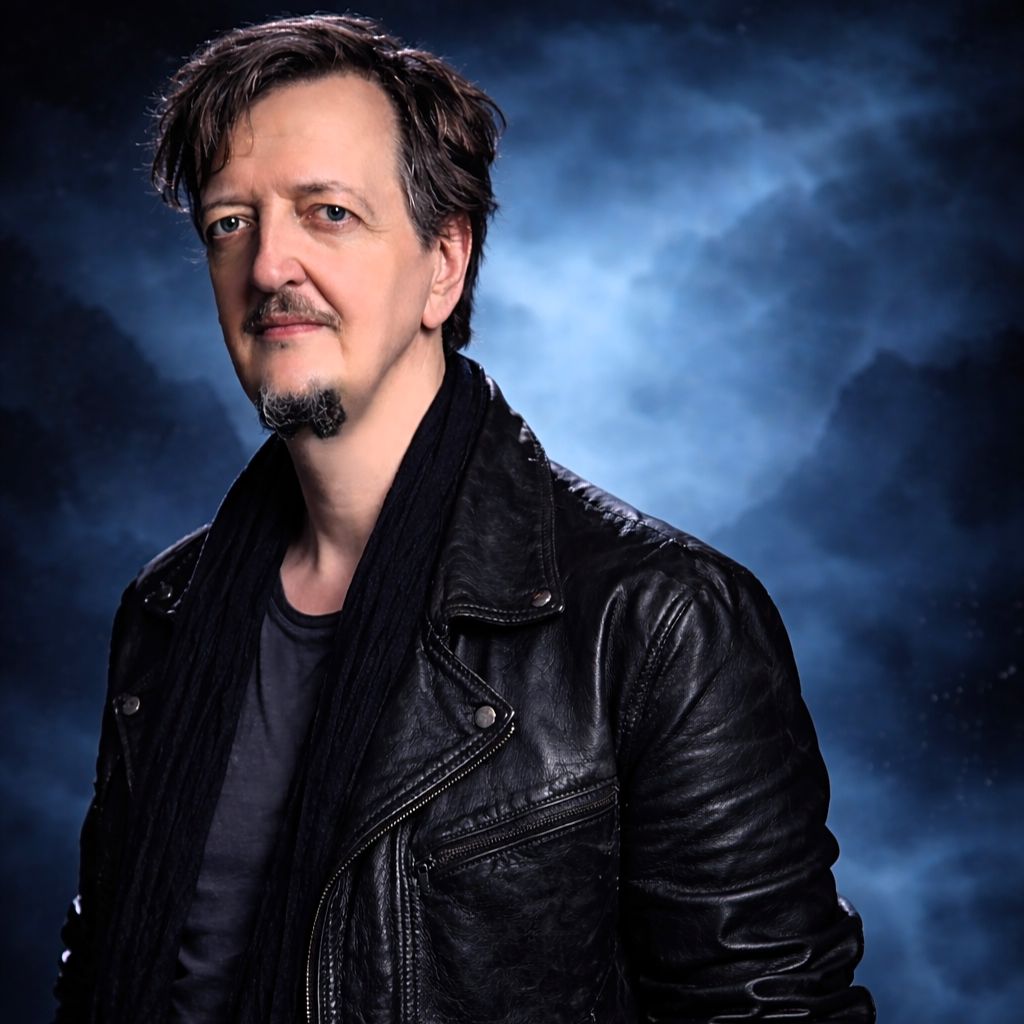
About
Thomas Alexander Kolbe is a musician (keys), composer, lyricist, vocalist, and producer working across instrumental ambient, vocal ambient, dream pop, vocal electronic music, and instrumental electronic music. His work moves between atmospheric instrumental compositions, vocal-centered pieces, and electronically structured material, ranging from slowly unfolding sound environments to more rhythmically defined and song-oriented forms.
At the center of Kolbe’s work is the artistic process itself. While he maintains a longstanding interest in the relationship between music, neuroscience, psychology, and perception, this engagement remains closely tied to creative practice rather than functioning as detached theoretical discourse. His interest in these subjects grows out of personal curiosity informed by academic research, while the music itself remains the primary focus.
Artistic Approach
Depending on the context of a piece, Kolbe follows very different dramaturgical approaches. Some works develop gradually through shifts in texture, continuity, atmosphere, and internal motion, particularly within ambient, vocal ambient, and dream pop. Other compositions employ more clearly defined structures, melodic development, rhythmic movement, or song-oriented progression. Rather than adhering to a single compositional model, his work moves between open-form atmospheric structures and more focused electronic forms depending on the artistic intention of the material.
Japanese sonic aesthetics and sensibilities have also influenced aspects of his work over time, though without becoming stylistic imitation or a rigid conceptual framework. These influences appear more as traces within pacing, atmosphere, restraint, tonal space, and approaches to perception than as direct references.
In his vocal works, the voice can fulfill different functions depending on the composition itself. In some tracks it remains embedded within the surrounding sound as a continuous or stabilizing presence. In others, the voice assumes a more active dramaturgical role within the structure of the piece. Kolbe’s vocal material therefore does not follow one fixed expressive model, but shifts according to atmosphere, lyrical intention, and compositional context.
Lyrics and Expression
Kolbe also writes the lyrics for his vocal works. Emotional, reflective, mythic, mystical, and occasionally existential elements frequently appear throughout his texts. Some lyrics remain intentionally open in meaning, while others follow more narrative directions or contain traces of personal worldview and experience.
Certain statements are deliberately embedded beneath metaphor, atmosphere, or layered imagery rather than communicated directly. At the same time, Kolbe is not interested in decorative abstraction or empty poetic phrasing for its own sake. Across both music and text, artistic elements are treated as carrying meaning and intentionality rather than existing merely as ornament.
This approach also affects the structure of longer vocal pieces. Even when tracks extend over longer durations, the lyrical progression, changing emotional emphasis, sonic development, and overall dramaturgy remain central to the listening experience. The extended format is therefore not conceived as static repetition, but as part of the artistic movement of the work itself.
Research and Reflection
Alongside his musical work, Kolbe writes essays and reflections dealing with subjects at the intersection of music, neuroscience, psychology, emotional processing, sleep, perception, memory, and physiological responses to sound.
A recurring concern within these writings is the distinction between subjective experience and generalizable knowledge. Research is therefore approached less as a source of final answers than as a framework for continued reflection, examination, and dialogue.
Questions surrounding perception, stillness, focus, internal states, and changing psychological conditions also recur throughout his broader artistic perspective. Practices such as meditation may intersect with these themes in certain contexts, though not in a prescriptive, ideological, or therapeutic sense. From this perspective, the music is not intended to control emotional states or impose fixed interpretations, but to leave space in which perception and experience may shift differently depending on the listener and the situation.
Background
Personal experiences with neurological and psychological changes have had a lasting influence on Kolbe’s artistic perspective and working process. These experiences rarely appear directly as explicit subject matter, but continue to inform his relationship to time, structure, perception, concentration, and creative process.
Kolbe is severely disabled and lives with neurological and psychological impairments. He also maintains close personal connections to both Germany and Japan. Music, writing, and artistic work play an important role in helping him navigate everyday life and various challenges connected to these conditions.
Projects
Alongside his solo work, he is part of the project “Club of Tone” together with vocalist Aina Agena. Under the name “Topazz,” he has also released music in the fields of house, chillout, and chillhouse. Additional projects and collaborations can be found throughout his discography.
Current Direction
Rather than following a single fixed artistic direction, Kolbe’s current focus lies in balancing different forms of creative activity depending on context, condition, artistic necessity, and personal orientation at a given time. The work balances accessibility with openness, allowing for different forms of listening and interpretation.
Painting
Alongside his musical work, Kolbe practices painting as a hobby. Working mainly in gouache on textured paper, he creates landscapes and illustrative scenes with an emphasis on visible brushwork, surface texture, and traditional materials.
Short Version
Thomas Alexander Kolbe is a musician (keys), composer, lyricist, vocalist, and producer working across instrumental ambient, vocal ambient, dream pop, vocal electronic music, and instrumental electronic music. His work combines a distinct artistic approach with an ongoing interest in music, neuroscience, psychology, perception, and emotional processing. Alongside his solo releases, he is part of the project “Club of Tone” with vocalist Aina Agena and has released house, chillout, and chillhouse music under the name “Topazz.”